Bring your own key routes self-healing CI through your own provider account, so inference bills to you instead of Nx Cloud.
It is a paid add-on, available on the Enterprise plan and enabled for your organization by Nx. Contact your developer productivity engineer to turn it on. The AI provider row does not appear in your organization settings until it is enabled. For the organization toggles that enable AI features and bring your own key, see Enable AI features.
Choose a mode
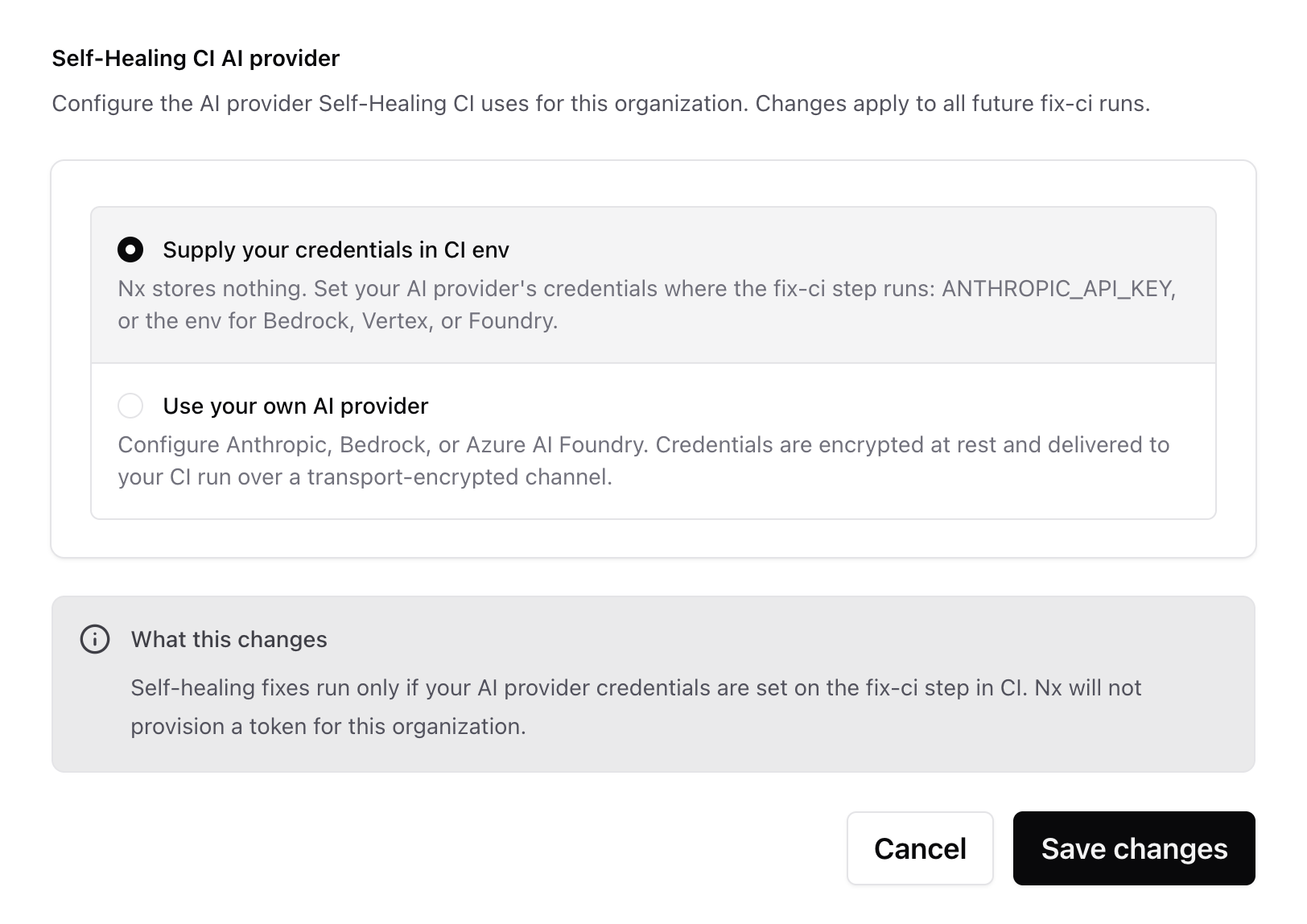
Section titled “Choose a mode”Credentials reach fix-ci one of two ways. In stored mode Nx Cloud holds them for you, and in CI env mode they stay in your own CI secret store. Pick between them at /orgs/<org-id>/ai-provider, where they appear as Use your own AI provider and Supply your credentials in CI env.
| Property | Stored in Nx Cloud | Set in your CI |
|---|---|---|
| Credential storage | Encrypted in Nx Cloud | Your CI secret store, Nx stores nothing |
| Configured by | An organization admin, in the settings UI | Your CI or platform team, on the fix-ci step |
| Providers | Anthropic, AWS Bedrock, Azure AI Foundry | Anthropic, AWS Bedrock, Azure AI Foundry, Google Vertex AI |
| IAM and STS authentication | Not supported | Supported |
Google Vertex AI and AWS IAM or STS credentials are only available in CI env mode.
Set the model tiers
Section titled “Set the model tiers”Self-healing CI uses three model tiers.
| Tier | Purpose | Environment variable |
|---|---|---|
| Primary | Fix generation. Use Opus, or Sonnet 4.5 and later. | ANTHROPIC_DEFAULT_SONNET_MODEL |
| Fallback | Used when the primary is overloaded. Must differ from the primary. | ANTHROPIC_DEFAULT_FALLBACK_MODEL |
| Low-power | Background work such as classification and summaries. Usually Haiku. | ANTHROPIC_DEFAULT_HAIKU_MODEL |
The variable names are slots, not model families. The primary tier reads ANTHROPIC_DEFAULT_SONNET_MODEL whichever model you put in it, so an Opus ID belongs there. Self-healing CI does not read ANTHROPIC_DEFAULT_OPUS_MODEL.
Each tier takes the model identifier your provider publishes:
- Anthropic: a Claude model name, from the Claude model list.
- AWS Bedrock: a Bedrock model ID, shaped
anthropic.<model>-<date>-v1:0. - Azure AI Foundry: the deployment name you gave the model.
- Google Vertex AI: a Vertex model ID.
In stored mode you enter these as form fields, and in CI env mode you set the variables.
Set up stored mode
Section titled “Set up stored mode”Select Use your own AI provider, then pick your provider and fill in the form. You need organization admin access, and a Claude model provisioned in your provider for each tier, which is a console step in AWS or Azure. Nx sets the runtime environment for every fix-ci run, so your CI configuration doesn't change.
To rotate a credential, use Replace credentials. Clearing the provider deletes the stored secret.
Set up CI env mode
Section titled “Set up CI env mode”Set the provider variables wherever fix-ci runs. Nx stores nothing, and the Claude Agent SDK reads the variables at session start.
fix-ci runs in two places, so the variables have to be present in both. It runs on your main CI job for failures outside agents, meaning non-distributed commands, and on Workers for distributed tasks that fail there. On the main job, set the variables the way you manage any other CI secret. Workers start clean, so forward the variables to the agents. Forwarding covers Anthropic and Foundry outright. AWS and Vertex need more care on the agents, covered in their sections below.
Anthropic
Section titled “Anthropic”In stored mode, supply an Anthropic API key. A gateway or proxy base URL is optional.
In CI env mode, set the following variables.
| Variable | Required | Value |
|---|---|---|
ANTHROPIC_API_KEY | Yes | Anthropic API key |
ANTHROPIC_BASE_URL | No | Gateway or proxy origin. Omit for api.anthropic.com |
ANTHROPIC_DEFAULT_*_MODEL | No | The three tiers. Unset falls back to the default Claude models |
AWS Bedrock
Section titled “AWS Bedrock”In stored mode, supply a long-term Bedrock API key as a bearer token, plus the AWS region. Short-term keys expire and break self-healing once they do.
In CI env mode, set the following variables.
| Variable | Required | Value |
|---|---|---|
CLAUDE_CODE_USE_BEDROCK | Yes | 1 |
AWS_REGION | Yes | Region serving your models, such as us-west-2 |
AWS_BEARER_TOKEN_BEDROCK | One auth path | Long-term Bedrock API key as a bearer token |
AWS_ACCESS_KEY_ID, AWS_SECRET_ACCESS_KEY, AWS_SESSION_TOKEN | One auth path | IAM or STS credentials |
ANTHROPIC_DEFAULT_*_MODEL | Yes | Bedrock model IDs |
Through CI, fix-ci doesn't authenticate with a single key. It calls the AWS SDK, which walks the standard AWS credential chain to find whatever credentials the runner exposes, whether that's environment variables, a shared credentials file, or an attached role. CLAUDE_CODE_USE_BEDROCK and AWS_REGION only say where to go, and supplying the credentials is the part you set up.
On your own runners, the AWS SDK can use whatever the machine already carries, such as an attached instance or task profile, a ~/.aws file, or credentials your CI injects through OIDC. Often you set only the region and the Bedrock flag, and the existing AWS identity does the rest.
Workers carry none of your AWS identity, so pass the credentials as environment variables. A long-term Bedrock API key in AWS_BEARER_TOKEN_BEDROCK is the shortest path. For IAM or STS, mint short-lived credentials on your main job and forward AWS_ACCESS_KEY_ID, AWS_SECRET_ACCESS_KEY, AWS_SESSION_TOKEN, and AWS_REGION to the agents.
Azure AI Foundry
Section titled “Azure AI Foundry”The host is services.ai.azure.com, not openai.azure.com. Model values are deployment names, one per tier.
The endpoint takes a resource name such as my-resource, or a bare origin such as https://my-resource.services.ai.azure.com, with no path. Nx and the Claude Agent SDK append /anthropic/v1/messages themselves, so a stored /anthropic doubles and returns a 404. The Nx Cloud form rejects a path and previews the resolved URL before you save.
In stored mode, supply a Foundry API key and an endpoint in either of those two forms.
In CI env mode, set the following variables.
| Variable | Required | Value |
|---|---|---|
CLAUDE_CODE_USE_FOUNDRY | Yes | 1 |
ANTHROPIC_FOUNDRY_RESOURCE | One of these two | Resource name only, such as my-resource. The SDK derives the origin |
ANTHROPIC_FOUNDRY_BASE_URL | One of these two | Bare origin, no path. Use for a custom origin |
ANTHROPIC_FOUNDRY_API_KEY | Yes | Foundry API key |
ANTHROPIC_DEFAULT_*_MODEL | Yes | Foundry deployment names |
Google Vertex AI
Section titled “Google Vertex AI”Vertex has no Nx Cloud form, so it runs in CI env mode only.
| Variable | Required | Value |
|---|---|---|
CLAUDE_CODE_USE_VERTEX | Yes | 1 |
ANTHROPIC_VERTEX_PROJECT_ID | Yes | Google Cloud project ID |
CLOUD_ML_REGION | Yes | global, a multi-region such as us or eu, or a region such as us-east5 |
GOOGLE_APPLICATION_CREDENTIALS | Yes | Path to a service account key file, unless Application Default Credentials are present |
ANTHROPIC_DEFAULT_*_MODEL | Yes | Vertex model IDs |
Current models take the bare identifier, such as claude-sonnet-5. A dated snapshot separates the date with @, shaped claude-<model>@<date>.
Authentication goes through the Google credential chain, which usually wants a service account key file rather than a single value. On your own runners, use Application Default Credentials through gcloud auth application-default login, or point GOOGLE_APPLICATION_CREDENTIALS at a key file already on the machine.
Forwarding to Workers passes values, not files, so carry the key file as a value and rebuild it on the agent:
- Put the service account JSON into an environment variable. Base64-encode it to avoid newline and quoting problems.
- Forward that variable to the agents.
- In the init step of your launch template, decode the value back out to a file and point
GOOGLE_APPLICATION_CREDENTIALSat that path.
For region and model details, see Claude on Google Vertex AI.
Verify the setup
Section titled “Verify the setup”Open a CI pipeline execution and check the self-healing tab for fix suggestions. Your nx fix-ci step should run without logging errors about a missing or rejected provider.