

Nx coordinates work in your workspace through a few core concepts: the project graph, inferred tasks, the task graph, affected commands, and computation caching. Plugins apply these concepts to the tools and frameworks in your repository.
The project graph
Section titled “The project graph”The project graph represents the source code in your repository and external dependencies such as Vite, React, and Angular.
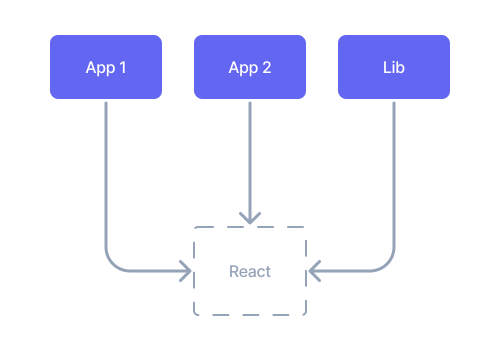
Nx analyzes your file system to detect projects. It identifies projects from a project.json file or a package.json file included in your package manager's workspaces configuration. Plugins can also customize how Nx identifies projects. You can manually define dependencies between the project nodes, but you don't have to do it very often. Nx analyzes source code, your installed dependencies, and TypeScript configuration to figure out these dependencies for you. Nx also stores the cached project graph, so it only reanalyzes the files you have changed.
Nx caches the project graph and recomputes the parts affected by file changes. The updated graph reflects the current state of your workspace.
Inferred tasks
Section titled “Inferred tasks”Every project has tasks you can run, such as build, test, or lint. Tasks can come from three places:
- Nx can use a script in the project's
package.json. - Nx can use a target defined in the project's
project.json. - A plugin can infer a task from tool configuration.
Your tools already describe how they run. A vite.config.ts file defines where the build output goes. Rather than asking you to repeat that information, Nx plugins read the tool configuration and create tasks for you. The @nx/vite plugin, for example, detects vite.config.ts files and infers tasks such as build, dev, and preview with the correct command, cache settings, inputs, outputs, and task dependencies.
To see every task Nx detected for a project, and where each setting came from, show the project details:
nx show project my-projectWhen a plugin infers settings you want to change, override them. Nx merges task configuration from three sources, with later sources winning:
- Task configuration inferred by plugins registered in
nx.json. targetDefaultsinnx.json.- The project's own configuration in
package.jsonorproject.json.
For all configuration options, see project configuration. To move an older workspace onto inferred tasks, follow the Migrate to Inferred Tasks guide.
The task graph
Section titled “The task graph”Nx creates a task graph whenever you run tasks. Each node is a task, which is a specific target invoked for a project, such as myapp:build. Edges represent the dependencies between tasks. For example, nx test lib creates a task graph with one node:
The project graph and task graph aren't identical. In this project graph, both applications depend on lib:
Nx uses the project graph to figure out which tasks exist, but the task graph isn't a mirror of the project graph. In the case below, app1 and app2 depend on lib:
Running nx run-many -t test -p app1 app2 lib creates a task graph with three disconnected nodes:
Even though the apps depend on lib, testing app1 doesn't depend on testing lib. This means that the three tasks can run in parallel.
Now let's make the test target depend on the test tasks of its dependencies:
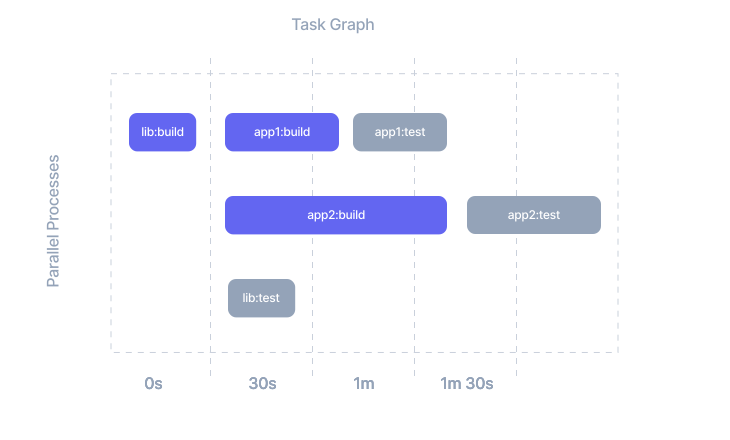
{ "targetDefaults": { "test": { "dependsOn": ["^test"] } }}With this, running the same test command creates the following task graph:
This often makes more sense for builds, where to build app1, you want to build lib first. You can also define similar relationships between targets of the same project, including a test target that depends on the build. Learn more about configuring task pipelines in Task Pipeline Configuration.
A task graph can contain different targets that run in parallel. For instance, while Nx builds app2, it can test app1 at the same time.
Nx also runs the tasks in the task graph in the right order. Nx executing tasks in parallel speeds up your overall execution time.
Affected commands
Section titled “Affected commands”Running nx test app1 creates the app1:test task and any tasks it depends on. Running nx run-many -t test -p app1 lib creates tasks for both projects. Without a project filter, nx run-many -t test creates a test task for every project with that target.
Use nx affected -t test to limit the task graph to projects affected by your changes. Nx maps changed files to projects, applies plugin-specific change analysis, and follows the project graph to include dependent projects. It then runs the requested target for that set.
For example, if a change affects lib, and both app1 and app2 depend on it, the affected project set contains all three projects.
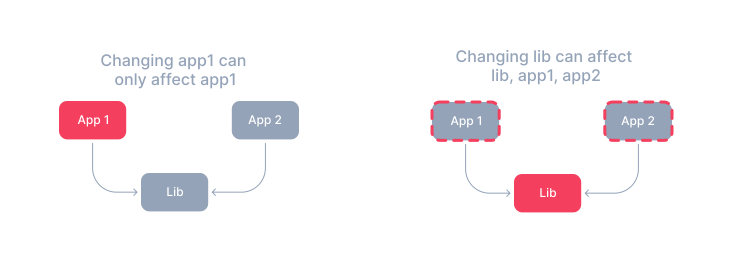
When you run nx affected -t test, Nx identifies the files changed in your PR and follows their project dependencies and imports to determine which projects the change can affect. It then runs the run-many command with that list.
For instance, when a PR changes lib, Nx detects that app1 and app2 depend on lib, then invokes nx run-many -t test -p app1 app2 lib.
Nx analyzes the nature of the changes. For example, if you change the version of Next.js in the package.json, Nx knows that app2 cannot be affected by it, so it only retests app1.
Computation hashing and caching
Section titled “Computation hashing and caching”Before running a task, Nx computes a hash based on source files, configuration, dependencies, and other inputs. If the hash matches a previous run, Nx replays the cached result, including terminal output and file artifacts. If not, Nx runs the task and stores the result for next time.
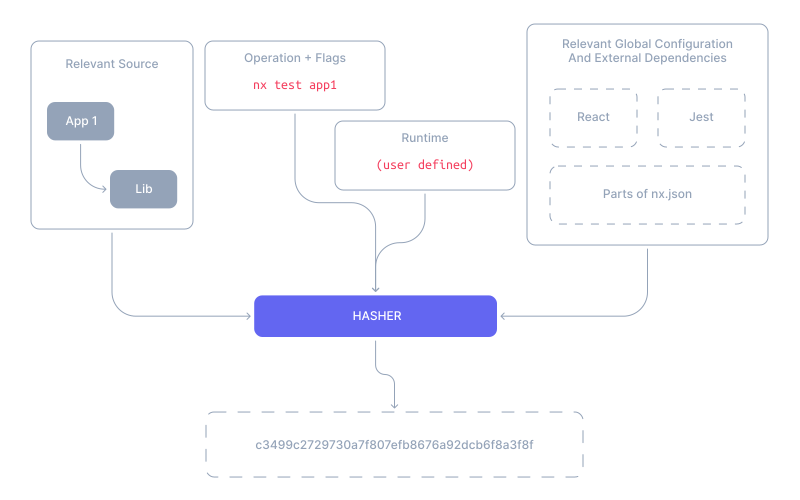
Nx checks the local cache first and then checks the remote cache when one is configured. A cache hit has the same result as executing the task, but avoids the computation.
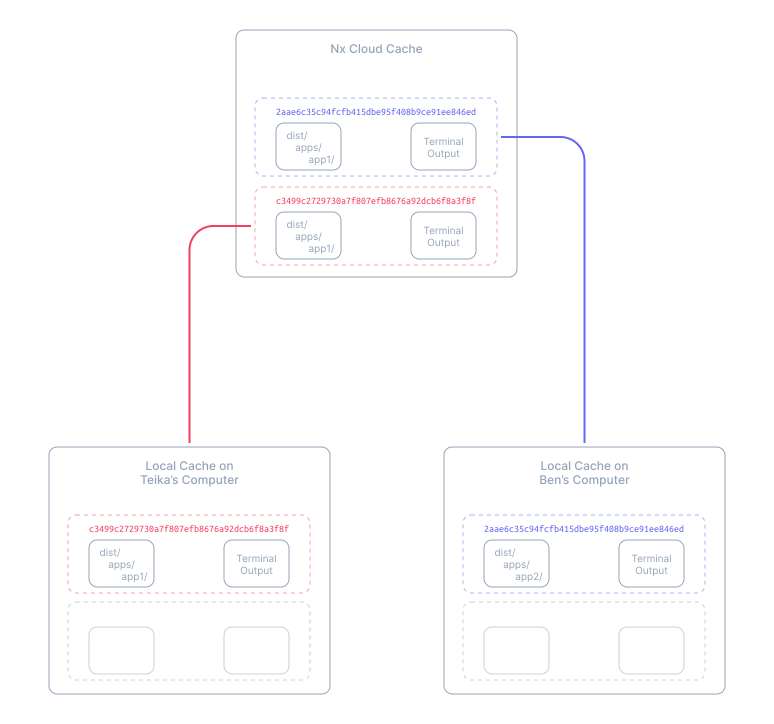
For the complete hashing and cache model, see how caching works.
Distributed task execution
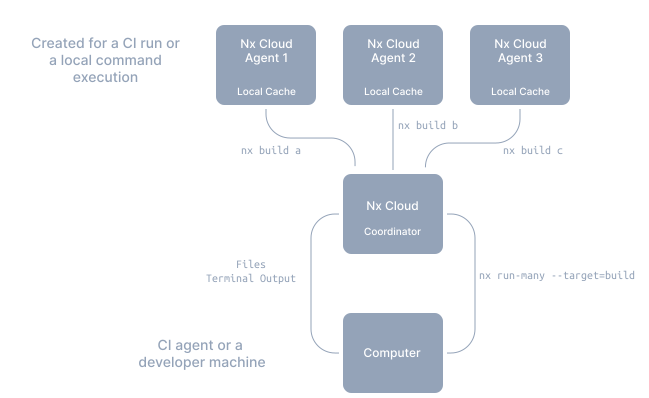
Section titled “Distributed task execution”For large workspaces, even with caching, running all tasks on a single machine can be slow. Nx Agents distribute the task graph across multiple machines, running tasks in parallel while using remote caching to share artifacts between agents. CI receives the results as though everything ran on a single machine.
How it fits together
Section titled “How it fits together”- Nx analyzes your source code to create a project graph.
- Nx plugins infer tasks from your tool configuration, so most task settings don't have to be written by hand.
- Nx uses the project graph and task configuration to create a task graph and run tasks in the right order.
- Code-change analysis creates the smallest task graph for your PR.
- Computation caching makes sure the same computation never runs twice. You can plug in a cache provider and distribute cached results.